Key Takeaways
- Over 2.5 million users joined the QuitGPT boycott after OpenAI's Pentagon deal announcement.
- ChatGPT uninstalls spiked 295% in a single day, while Claude hit No.1 on the U.S. App Store.
- Anthropic's refusal of the deal led to a 'supply chain risk' designation by the government.
- OpenAI's approach relies on deployment architecture and technical safeguards to enforce ethical 'red lines'.
- The movement proves that AI ethics and corporate governance are now measurable factors in consumer market share.
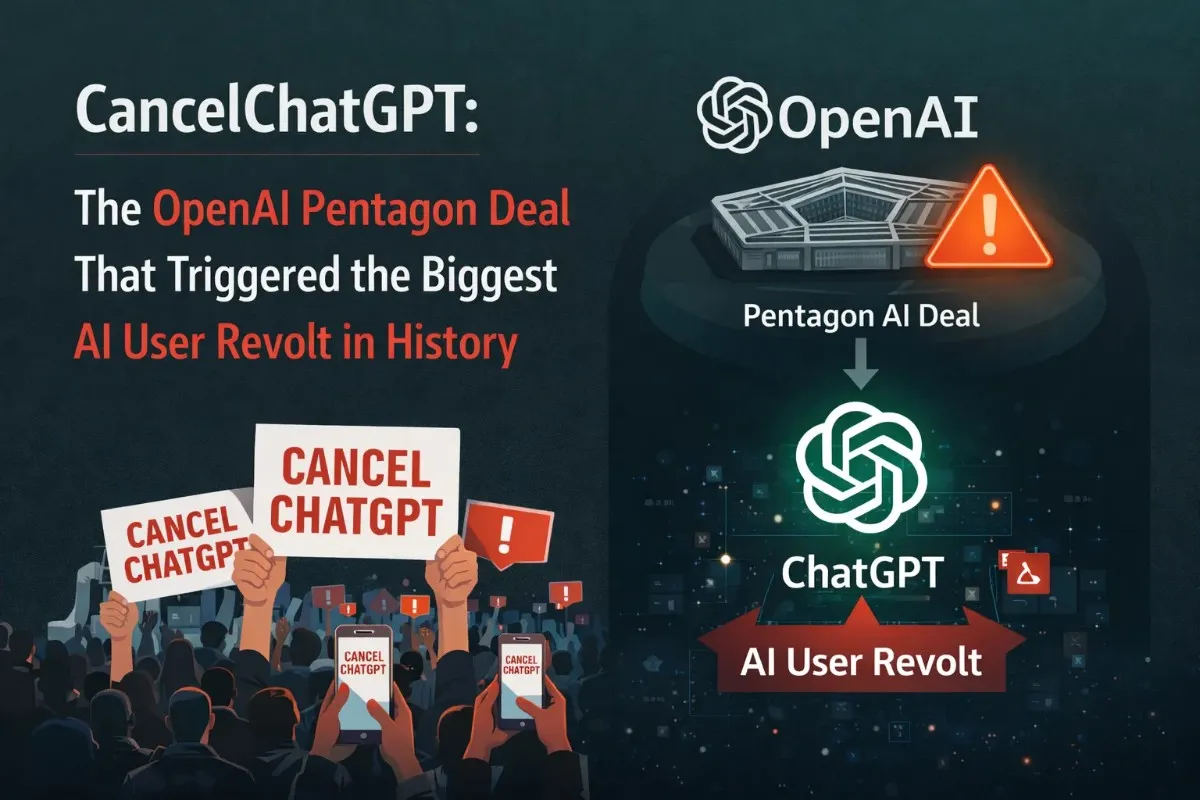
CancelChatGPT: The OpenAI Pentagon Deal That Triggered the Biggest AI User Revolt in History
In 48 hours at the end of February 2026, ChatGPT uninstalls spiked 295%, one-star App Store reviews exploded by 775%, Claude became the No.1 free app in America for the first time ever, and over 2.5 million users joined a boycott movement called QuitGPT. It all started with one Pentagon contract, one company that said no, and one company that said yes hours later. Here is the complete story.
By the Numbers: The Scale of the ChatGPT Revolt
Before the full story, here is the raw data. These numbers tell you something that has never happened before in the AI industry: a single corporate decision moved millions of users in under 72 hours.
| Metric | Figure |
|---|---|
| Total users who joined the QuitGPT boycott | 2.5 million+ |
| ChatGPT uninstall spike on February 28 (single day) | 295% |
| One-star App Store review spike on February 28 | 775% |
| Claude usage surge on Friday February 27 | 37% |
| Claude usage surge on Saturday February 28 | 51% |
| Claude App Store ranking (U.S.) after the revolt | No.1 free app: first time in Claude's history |
| Anthropic free user growth since January 2026 | 60%+ |
| Anthropic paid subscriber growth in 2026 | More than doubled |
| OpenAI employees who signed open letter supporting Anthropic | 60+ |
| Google employees who signed the same open letter | 300+ |
| Countries where Claude hit No.1 or No.2 in App Store | United States, Germany, Canada (No.1), Switzerland (No.2) |
| Anthropic valuation at time of boycott | ~$380 billion (post-February 2026 Series G) |
| OpenAI valuation at time of deal | ~$730 billion |
What Actually Happened: The Complete Timeline
To understand the CancelChatGPT explosion, you need to understand that it did not start with the Pentagon deal. The revolt had been building for months, triggered by a series of decisions that each chipped away at user trust. The Pentagon deal was the final straw, not the first match.
The Background: What Was Already Brewing Before the Deal
Several events throughout late 2025 and early 2026 had already eroded trust with a vocal portion of OpenAI's user base before the Pentagon announcement:
- FEC filings in late January 2026 revealed that OpenAI President Greg Brockman and his wife had each donated $12.5 million to MAGA Inc., the pro-Trump super PAC, making Brockman one of the largest individual donors to the Trump campaign ecosystem
- A Department of Homeland Security AI inventory disclosed that U.S. Immigration and Customs Enforcement was using a resume screening tool powered by ChatGPT-4
- Long-term heavy users, particularly developers and coders, reported a sustained decline in model quality and response sharpness throughout 2025
- OpenAI's shift toward commercial prioritization had raised ongoing concerns among AI safety advocates who had previously viewed the company as more principled
- A loose coalition of activists, climate organizers, and self-described cyber libertarians had already launched QuitGPT.org in early February, before the Pentagon deal was announced
Actor Mark Ruffalo amplified the early movement to his millions of followers, posting: "ChatGPT's President is Trump's biggest donor." The audience was already primed. All it needed was a trigger.
The Anthropic Standoff: How the Pentagon Dispute Began
For months, the U.S. Department of Defense, rebranded by the Trump administration as the Department of War, had been negotiating with AI companies to gain access to their models for military operations. The core demand was broad: the Pentagon wanted AI it could deploy for "any lawful purpose," a scope that included autonomous weapons systems and domestic surveillance operations.
Anthropic had originally signed a $200 million contract with the Pentagon in July 2025 to integrate Claude into classified military networks. That initial arrangement included Anthropic's acceptable use policy as a contractual constraint. The dispute came later, in early 2026, when the Pentagon sought to renegotiate those terms and remove the usage restrictions entirely.
In a public statement, Anthropic CEO Dario Amodei drew a clear line, saying he could not "in good conscience" give the military unrestricted AI access. Specifically, Anthropic's two non-negotiable restrictions were:
- No use of Claude for mass domestic surveillance of American citizens
- No use of Claude for fully autonomous weapons systems that operate without human oversight
Defense Secretary Pete Hegseth responded with fury. He issued an ultimatum with a deadline of 5:00 p.m. ET on Friday, February 27, 2026, for Anthropic to remove these restrictions or lose the contract entirely. Anthropic's response was that the Department's latest language "framed as compromise was paired with legalese that would allow those safeguards to be disregarded at will." The deadline passed without agreement.
The Escalation: Trump Bans Anthropic, Hegseth Labels It a National Security Risk
The government's response to Anthropic's refusal was unprecedented. Within hours of the deadline passing on February 27, two actions were taken simultaneously:
- President Trump posted on Truth Social calling the people at Anthropic "Leftwing nut jobs" and directed every federal agency to immediately cease using Anthropic's technology, with a six-month phase-out period
- Defense Secretary Hegseth announced he was designating Anthropic a supply chain risk to national security, declaring: "Effective immediately, no contractor, supplier, or partner that does business with the United States military may conduct any commercial activity with Anthropic"
The supply chain risk designation is a label that has historically been applied to foreign adversaries, most notably Chinese telecommunications companies like Huawei. Anthropic became the only American company ever publicly designated with this label, a fact that legal experts and former military officials described as legally dubious and constitutionally questionable. Anthropic has since filed a lawsuit against the Pentagon, calling the actions "unprecedented and unlawful" and citing free speech and due process violations.
OpenAI Signs the Deal: The Move That Sparked the Revolt
What happened next is what turned a simmering frustration into a consumer explosion. Just hours after Anthropic's ban was announced on February 27, Sam Altman posted on X that OpenAI had reached an agreement with the Department of Defense to deploy its models in classified military networks.
The contrast was immediate and devastating for OpenAI's public image. One company had publicly refused the deal on principle and lost a $200 million contract for doing so. Hours later, its biggest competitor announced it had taken the same deal. In the court of public opinion, the narrative wrote itself: OpenAI had waited to see what would happen to Anthropic and then stepped in to fill the gap.
Altman himself acknowledged the damage almost immediately. In an all-hands meeting with OpenAI employees, he admitted the deal had been "definitely rushed" and that "the optics don't look good." By Monday March 3, he was posting public acknowledgments that the rollout had been mishandled, writing internally: "We shouldn't have rushed."
What Is Actually in the OpenAI Pentagon Contract
OpenAI has not released the full text of its contract with the Pentagon. This absence of transparency has been the central point of criticism since the announcement, and it remains unresolved. What the company has shared publicly are the terms it says are included, which it describes as three red lines.
OpenAI's Three Stated Red Lines
- No use of OpenAI technology for mass domestic surveillance of U.S. persons and nationals
- No use of OpenAI technology to direct autonomous weapons systems without meaningful human involvement
- No use of OpenAI technology for high-stakes automated decisions such as social credit systems
The Architecture Argument: Why OpenAI Says Its Deal Is Safer Than Anthropic's
OpenAI's position is that it protects these red lines primarily through deployment architecture rather than contract language alone. The key elements of this approach are:
- Cloud-only deployment: models run on OpenAI's cloud infrastructure, not on edge devices or embedded in weapons systems directly
- Full safety stack retained: OpenAI retains full control over the safety guidelines governing its models and will not provide a version of its AI with safety guardrails removed
- Cleared OpenAI personnel in the loop: security-cleared OpenAI employees will monitor deployment and help improve systems over time
- Strong contractual protections: in addition to the technical controls, the contract contains explicit language prohibiting the stated misuses
On March 3, 2026, following intense criticism, Altman announced a contract amendment that explicitly added: "The AI system shall not be intentionally used for domestic surveillance of U.S. persons and nationals." The amended language also extended to "commercially acquired" personal data, closing a loophole in the original text that critics said would have permitted geolocation data, web browsing history, and personal financial information purchased from data brokers to be used in surveillance operations.
Why Critics Are Not Satisfied
Despite the amendment, significant concerns remain unresolved. Legal experts, former military officials, and privacy advocates have raised the following objections:
- The word "intentionally" in the surveillance prohibition gives the Pentagon a wide escape hatch: a former Pentagon official told The Intercept: "That's the get out of jail free card right there. The language gives them enough flexibility to still do whatever they want, and then say, whoops, didn't mean to"
- The contract has not been released publicly, so independent verification of the stated protections is impossible. As former Army undersecretary Brad Carson said: "There is nothing OpenAI can do to clarify this except release the contract"
- The contract relies on existing laws as a backstop, but experts note that executive orders and new legal opinions could redefine the boundaries of "lawful use" without changing the contract itself
- OpenAI's head of national security partnerships Katrina Mulligan, when pressed to release the specific contract language on surveillance protections, replied: "I do not agree that I am obligated to share contract language with you": a response that amplified rather than quieted public concerns
- MIT Technology Review noted that if you believe the government will not follow the law, then you should also not be confident it would honor red lines in any contract, making OpenAI's trust-in-law argument circular
"Imperfect enforcement does not make constraints meaningless, and contract terms still shape behavior, oversight, and political consequences."
MIT Technology Review, March 2, 2026
The Consumer Revolt: How QuitGPT Moved Market Share
Tech boycotts have a poor track record. Users complain, post screenshots for a week, and then quietly return to the product because the alternatives are worse or the switching effort is too high. The CancelChatGPT movement is different, and the data supports why it has lasted longer than anyone expected.
The 48-Hour Explosion
The timeline of the revolt unfolded with unusual speed:
- Thursday evening, February 27: Sam Altman posts the Pentagon deal announcement on X. The hashtag #CancelChatGPT begins trending within hours
- Friday, February 28: Claude usage surges 37%. Early cancellation numbers climb past 500,000 within 24 hours. OpenAI publishes its full blog post about the deal, which critics immediately pick apart for surveillance loopholes
- Saturday, February 28: ChatGPT mobile uninstallations nearly triple compared to the prior Saturday. Claude surges another 51%. Claude becomes the No.1 free app on Apple's U.S. App Store, the first time in its history. One-star reviews for ChatGPT spike 775% in a single day
- Sunday, March 1: QuitGPT organizes an in-person protest outside OpenAI's San Francisco headquarters. Sidewalks are covered in chalk graffiti reading "Show the contract" and "Take a stand for civil liberty." The boycott count passes 1.5 million
- Monday, March 3: Sam Altman tells reporters he "shouldn't have rushed" the Pentagon announcement. He announces the contract amendment with stronger surveillance language. Altman approaches Pentagon undersecretary Emil Michael directly to rework the terms
- Week of March 8: The boycott count passes 2.5 million. Claude remains atop App Store charts in the U.S., Germany, and Canada. More than 60 OpenAI employees and 300 Google employees have signed open letters supporting Anthropic's original position
Why This Boycott Is Different from Previous AI Controversies
Every previous AI controversy from deepfakes to copyright lawsuits generated headlines but did not move download numbers. This one did, for three structural reasons:
- A genuinely competitive alternative exists. Claude is not a sacrifice. It is a capable, well-designed product that many users find superior for reasoning and writing tasks. Switching is not a downgrade. This single factor explains more of the movement's staying power than anything else
- Switching costs are near zero. Anthropic built and launched a memory import tool that allows users to copy their stored ChatGPT memories into Claude in minutes. The technical barrier that keeps most users locked into a platform was effectively removed
- The narrative had perfect moral clarity. One company said no to a $200 million government contract on principle. Hours later, its competitor said yes. Whether that framing is entirely fair is debatable. But in the context of social media where simplicity wins, the story was perfectly shaped for viral spread
"This is the first time consumer backlash has materially shifted market share in the AI industry. Previous controversies generated headlines but did not move download numbers."
Let's Data Science, CancelChatGPT Analysis, March 2026
The Anthropic Angle: Principled Stance or Messy Reality
The CancelChatGPT narrative frames Anthropic as the hero and OpenAI as the villain. The full picture is more complicated, and understanding it is important for anyone trying to form an honest opinion about this controversy.
Anthropic originally signed a $200 million contract with the Pentagon in July 2025, becoming the first frontier AI model approved for use on classified networks. The company did not refuse military contracts in principle. The dispute was specifically about the Pentagon's later demand to remove the acceptable use policy restrictions and allow deployment for "any lawful purpose." This distinction matters: Anthropic's position was not anti-military. It was anti-unrestricted-autonomy.
It is also worth noting that U.S. Central Command used Anthropic's Claude AI during airstrikes on Iran in late February 2026, hours after President Trump ordered federal agencies to stop using the company's technology. The Wall Street Journal reported this detail, which highlights how deeply embedded these AI models already are in operational military workflows, and how the procurement dispute and the operational reality exist in separate worlds.
The irony that MIT Technology Review identified is striking: Anthropic drew a public line and paid a severe political price for it. OpenAI crossed that same line and paid a severe commercial one. Neither company's position is without complications. Anthropic is now politically labeled a national security risk by its own government and faces ongoing existential legal uncertainty. OpenAI gained a contract but lost the trust of millions of its most vocal users at a moment when that trust was a competitive differentiator.
What the CancelChatGPT Movement Means for the AI Industry
Regardless of how the legal battles resolve and how the OpenAI contract evolves, the CancelChatGPT movement has already changed several things about the AI industry that are unlikely to reverse.
AI Ethics Is Now a Consumer Product Feature
For years, AI safety advocates argued that responsible development would eventually become a competitive advantage. The events of late February 2026 are the strongest evidence yet yet that this thesis holds in the consumer market. Users are prioritizing governance and corporate ethics alongside product quality when choosing which AI tools to use. In an industry where word-of-mouth drives adoption, the alignment between a company's stated values and its actual decisions has become a measurable factor in market share.
AI Platform Lock-In Is Much Weaker Than Anyone Thought
The speed of the ChatGPT-to-Claude migration demonstrated that AI chatbot switching costs are far lower than traditional software. Users can move their memories, their preferences, and their workflows in minutes. This means:
- User bases are more fluid than platform metrics suggest, and market share can shift materially in 48 hours
- AI companies that assume loyalty based on habit are overestimating their moat
- Data portability features, like Anthropic's memory import tool, become genuine competitive weapons in a trust controversy
- The AI industry is evolving into infrastructure, where long-term stability and ethical governance are now key product features alongside capability benchmarks
The Political Dimension Is Now Permanent
The QuitGPT movement started over political donations and ICE contracts before the Pentagon deal ever happened. That means the political dimension of AI company choices is not going away when this specific controversy fades. Users have demonstrated they are willing to factor in a company's political relationships, government contracts, and corporate ethics into their platform decisions. For AI companies operating in an era of increasingly politicized technology policy, this represents a new and permanent variable in consumer behavior.
Government AI Contracts Now Carry Consumer Risk
The most important lesson for AI companies going forward is that government contracts are no longer simply revenue. They now carry a consumer-facing risk that must be weighed alongside the financial value. OpenAI's Pentagon deal may generate significant revenue over its lifespan. But it cost the company something that its $730 billion valuation did not model: the trust of its most vocal users at the exact moment a credible alternative was available to receive them.
Final Thoughts: The First AI Revolt That Actually Changed the Market
The CancelChatGPT movement will be studied as a turning point in the AI industry for years. Not because it destroyed OpenAI, it did not, and one of the world's most valuable companies will absorb 2.5 million boycotters without an existential crisis. But because it proved something that was previously theoretical: consumer values can materially move market share in AI, and the conditions for that to happen can emerge overnight.
The AI industry has spent years assuming that capability is the only axis that matters. More capable model equals more users equals more revenue. The events of late February and early March 2026 introduced a second axis that was always there but never tested at this scale: trust. When a credible alternative exists and switching costs are near zero, a single decision that violates user trust can move 2.5 million subscriptions in 72 hours.
For Anthropic, the outcome is bittersweet. The company gained more users in two weeks than it typically gains in months, and Dario Amodei's principled stance has been widely credited as a landmark moment for responsible AI development. But Anthropic simultaneously faces a government that has labeled it a national security risk, potential exclusion from defense contractor ecosystems, and ongoing legal battles whose outcome will shape the company's commercial future for years.
For OpenAI, the calculus is equally uncomfortable. The company gained a classified government contract but spent the weeks that followed in crisis mode, amending contract language, writing internal memos, conducting damage-control AMAs, and watching its most vocal users post screenshots of their cancellations to applause from tens of thousands of followers.
The broader question the CancelChatGPT movement raises has no easy answer: when the most powerful AI tools in the world are being integrated into classified military operations, who decides the limits? The government? The companies? The contracts? Or, as February 2026 demonstrated for the first time, the users?
💡 Strategic Insight
This isn't just technical knowledge, it's the kind of engineering thinking that separates production systems from toy projects. Apply these patterns to reduce costs, improve reliability, and ship faster.
Frequently Asked Questions
CancelChatGPT and QuitGPT are user-led boycott movements that launched in February 2026 after OpenAI signed a contract with the U.S. Department of Defense to deploy its AI models in classified military networks. The movement grew after Anthropic refused the same deal over concerns about mass domestic surveillance and autonomous weapons. Over 2.5 million users cancelled or suspended ChatGPT subscriptions and the QuitGPT.org website was created to help users delete their accounts and switch to alternatives.
OpenAI signed a contract with the U.S. Department of Defense on February 28, 2026, to deploy its AI models in the Pentagon's classified network. The company said the deal includes three red lines: no use for mass domestic surveillance, no use to direct autonomous weapons systems, and no use for high-stakes automated decisions. The full contract has not been released publicly. OpenAI later amended the contract on March 3, 2026, after backlash over surveillance language loopholes.
Anthropic refused to sign a Pentagon contract because the Department of Defense demanded the ability to use its AI for 'any lawful purpose,' which Anthropic said included mass domestic surveillance and fully autonomous weapons. OpenAI accepted a deal it says maintains the same red lines through deployment architecture rather than explicit contract prohibitions. Sam Altman said the approach differed: Anthropic focused on specific contract prohibitions while OpenAI relied on applicable laws and technical safeguards.
After Anthropic refused the Pentagon's terms, Defense Secretary Pete Hegseth designated Anthropic a supply chain risk on February 27, 2026, declaring that no contractor, supplier, or partner doing business with the U.S. military may conduct any commercial activity with Anthropic. President Trump also directed all federal agencies to cease using Anthropic's technology within six months. Anthropic has said it will challenge the designation in court, calling the actions unprecedented and unlawful.
More than 2.5 million users joined the QuitGPT boycott following OpenAI's Pentagon announcement. ChatGPT mobile app uninstalls spiked 295% in a single day on February 28, 2026. One-star App Store reviews surged 775% in a single day. Claude rose 37% on Friday and 51% on Saturday, hitting the No.1 free app position on Apple's U.S. App Store for the first time in its history. Anthropic reported more than 60% growth in free users since January 2026.
While the peak of the CancelChatGPT movement was in the final days of February and first days of March 2026, the boycott is ongoing. ChatGPT has returned to the top of App Store charts as of mid-March, but the structural shift in user perception remains. Anthropic continues to report record user growth, Anthropic's lawsuit against the Pentagon designation is active, and QuitGPT.org continues to attract new signups.
Tagged with
TL;DR
- Over 2.5 million users joined the QuitGPT boycott after OpenAI's Pentagon deal announcement.
- ChatGPT uninstalls spiked 295% in a single day, while Claude hit No.1 on the U.S. App Store.
- Anthropic's refusal of the deal led to a 'supply chain risk' designation by the government.
- OpenAI's approach relies on deployment architecture and technical safeguards to enforce ethical 'red lines'.
- The movement proves that AI ethics and corporate governance are now measurable factors in consumer market share.
Need help implementing this?
I help teams architect scalable systems, build AI-powered applications, and ship production-ready software.
Written by
Gaurav Garg
Full Stack & AI Developer · Building scalable systems
I write engineering breakdowns of major tech events, architecture deep dives, and practical guides based on real production experience. Every post is built from code, not theory.
7+
Articles
5+
Yrs Exp.
500+
Readers
Get tech breakdowns before everyone else
Engineering insights on AI, cloud, and modern architecture, delivered when it matters. No spam.
Join 500+ engineers. Unsubscribe anytime.