Key Takeaways
- First Google open model to ship under the Apache 2.0 license, offering full commercial freedom.
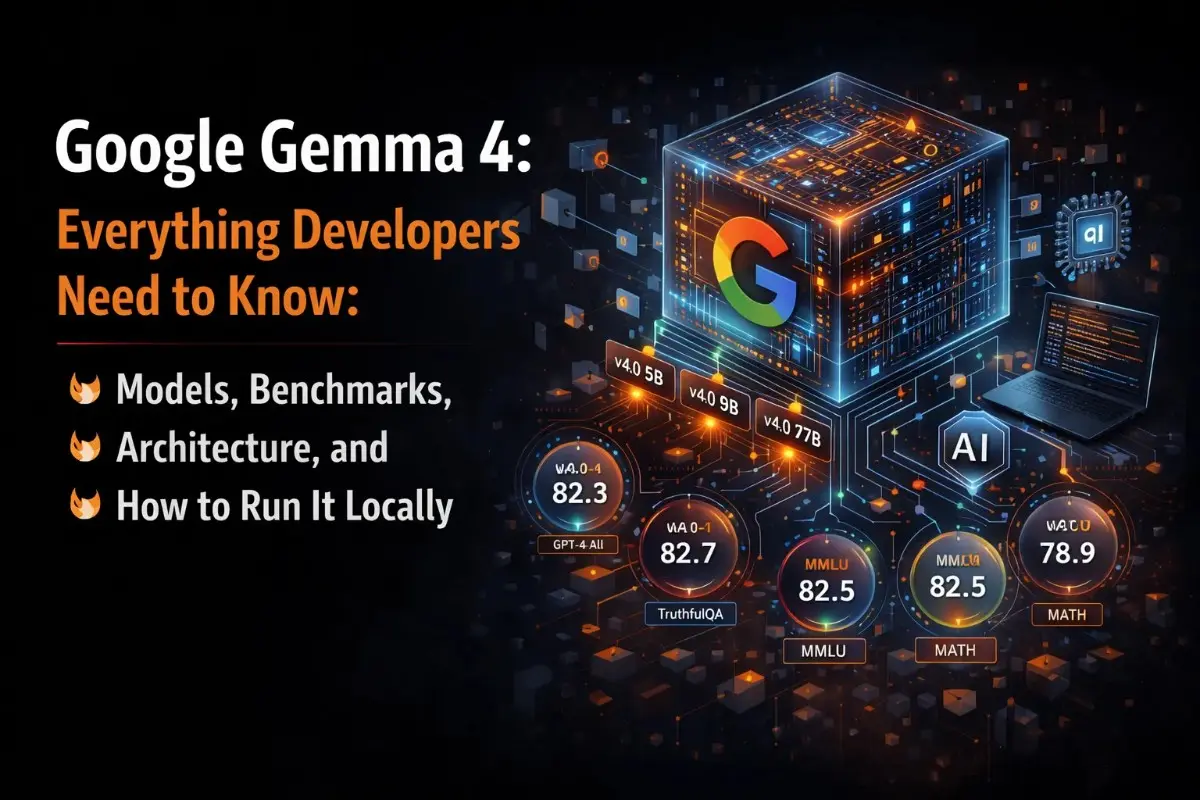
- The family spans four sizes: E2B, E4B, 26B MoE, and 31B Dense, optimized for everything from mobile to data centers.
- Features a massive 256K context window with native multimodal support for text, image, video, and audio.
- Dramatic performance gains in reasoning, coding, and agentic workflows, rivaling much larger state-of-the-art models.
- Native function calling and a built-in 'thinking mode' for complex multi-step logical tasks.
Open-weight AI models have spent the last two years being the "free but worse alternative" - something you used when budget was the constraint, not when quality was the priority. Google just ended that narrative. On April 2, 2026, Google DeepMind released Gemma 4, four open-weight models that run on anything from a Raspberry Pi to a workstation GPU, beat models many times their size on key benchmarks, and ship under the Apache 2.0 license with zero commercial restrictions.
That last part deserves to be said clearly before anything else. Every previous Gemma release used a Google proprietary license: permissive-ish, but not commercially clean, and carrying the kind of terms that made enterprise legal teams nervous. Gemma 4 is Apache 2.0. No monthly active user caps. No acceptable-use policy enforcement. No royalties. No permission needed. You build with it, you ship with it, and Google cannot change the terms later. For the developer community that has been watching open-source AI with one eyebrow permanently raised, that change matters as much as the benchmark numbers.
The Four Models: What Shipped and Who Each One Is For
Gemma 4 is not a single model. It is a family of four, each targeting a different point in the hardware spectrum. Understanding which model fits your use case is where this guide starts.
| Model | Effective Params | Total Params | Context Window | Modalities | Target Hardware |
|---|---|---|---|---|---|
| E2B | 2.3B | 5.1B | 128K | Text, Image, Video, Audio | Smartphones, Pi, Jetson |
| E4B | 4.5B | ~9B | 128K | Text, Image, Video, Audio | Laptops, mid-range GPUs |
| 26B MoE (A4B) | 3.8B active | 26B | 256K | Text, Image, Video | 16-24 GB GPU, Mac 32 GB |
| 31B Dense | 31B | 31B | 256K | Text, Image, Video | 80 GB H100, multi-GPU |
The "E" prefix on the smaller models stands for effective parameters, a naming convention that reflects a technique called Per-Layer Embeddings (PLE). PLE feeds a secondary embedding signal into every decoder layer, which means the model activates fewer parameters per inference step than its total count suggests. The E2B has 5.1 billion total parameters but behaves at inference like a 2.3 billion parameter model in terms of memory and compute. This is how Google fits genuinely capable AI onto a phone without compromise.
The 26B MoE model deserves separate attention because it is where the most interesting engineering happens. MoE, or Mixture of Experts, is an architecture where the model routes each input token through a subset of its total parameters rather than running everything at once. The 26B MoE has 128 experts but activates only a portion during each inference pass, resulting in just 3.8B active parameters at any given moment. The practical effect: you get reasoning quality that approaches the 31B dense model while running it at the compute cost of a small model. This is the variant most developers building production applications will want to evaluate first.
The Benchmark Numbers and Why the Generational Jump Is Real
Model releases in 2026 are accompanied by benchmark claims so routinely that most developers have learned to wait for independent evaluations. With Gemma 4, the numbers merit attention before those arrive, because the improvements over Gemma 3 are large enough that they change what the models are capable of qualitatively, not just quantitatively.
| Benchmark | Gemma 3 27B | Gemma 4 31B | Gemma 4 26B MoE |
|---|---|---|---|
| AIME 2026 (Math) | 20.8% | 89.2% | 88.3% |
| LiveCodeBench v6 (Coding) | 29.1% | 80.0% | 77.1% |
| GPQA Diamond (Science) | ~42% | 84.3% | 82.3% |
| MMLU Pro (Knowledge) | ~67% | 85.2% | ~84% |
| tau2-bench Retail (Agentic) | 6.6% | 86.4% | 85.5% |
The Codeforces ELO jump from 110 to 2,150 is the number that stops most developers in their tracks. An ELO of 110 in Codeforces essentially means the model cannot solve competitive programming problems. An ELO of 2,150 places it at expert level - above the vast majority of human competitive programmers. That is not an incremental improvement. It is a qualitative shift in what the model can do.
The agentic benchmark tells a similar story. Gemma 3 27B scored 6.6% on the tau2-bench Retail agentic workflow benchmark, which tests multi-step tool use in realistic scenarios. Gemma 4 31B scores 86.4% on the same benchmark. That 13x improvement reflects the architectural change in how Gemma 4 handles function calling, which was trained into the model from the ground up rather than layered on through instruction following.
Architecture: What Actually Changed from Gemma 3
For developers building on top of Gemma models, understanding what changed architecturally matters more than benchmark numbers alone. Gemma 4 introduces several significant design choices that affect both capability and deployment.
Alternating Attention
Gemma 4 layers alternate between two attention mechanisms: local sliding-window attention covering 512 to 1,024 tokens, and global full-context attention that spans the entire sequence. The alternating design balances inference efficiency against long-range understanding. By interleaving them, Gemma 4 achieves the 256K context window without the quadratic compute cost of applying global attention to every layer.
Native Multimodal Architecture
Gemma 4 integrates all modalities at the architecture level from the start. The vision encoder uses a learned 2D position encoder with multidimensional RoPE that preserves original image aspect ratios rather than forcing a fixed resolution. Token budgets per image are configurable from 70 to 1,120, letting developers trade off visual detail against compute. The audio encoder handles up to 30 seconds of audio natively on the E2B and E4B models, enabling speech recognition without an external ASR pipeline.
Built-in Thinking Mode
Gemma 4 includes a native thinking mode that generates internal chain-of-thought reasoning before producing a final answer. The model can generate over 4,000 tokens of internal reasoning before responding. This is what drives the dramatic improvement on math and complex logic benchmarks.
The Apache 2.0 License: Why It Is the Biggest Story
Every previous Gemma release shipped under Google's proprietary Gemma License. It was permissive in many respects but carried restrictions that created legal uncertainty for enterprise teams, particularly around redistribution and modification. Gemma 4 ships under Apache 2.0. What that means in practice:
- Full commercial freedom with no user caps or royalty requirements.
- Ability to fine-tune on proprietary data and redistribute open weights.
- Deployable in regulated industries like healthcare and finance without special negotiations.
- Irrevocable terms: Google cannot change the license retroactively.
Where to Access and How to Run Gemma 4
Gemma 4 has broader day-one availability than any previous Gemma release. Here is where the models are accessible immediately:
- Ollama: The fastest path. Run
ollama run gemma4:27borollama run gemma4:31bfor instant local inference. - Hugging Face: Full weight repositories for all four model sizes.
- Google AI Studio: Free browser-based playground for testing reasoning and multimodality.
- LM Studio: GUI-based local model browser for easy cross-platform deployment.
- Android AICore: Native support for E2B and E4B on supported Android devices.
The open-weight AI landscape in April 2026 is genuinely competitive. Gemma 4 is not the only strong option, but it is the most capable locally-runnable model Google has ever released, under the cleanest license the family has ever seen. For developers building the next generation of AI-powered applications, Gemma 4 represents a major new foundation.
How Gemma 4 Compares to Llama 4 and Qwen 3.5
| Factor | Gemma 4 31B | Llama 4 Scout (109B / 17B active) | Qwen 3.5 |
|---|---|---|---|
| License | Apache 2.0 (fully open) | Llama Community (700M MAU cap) | Apache 2.0 |
| Context Window | 256K tokens | 10M tokens | 128K tokens |
| AIME 2026 | 89.2% | Not published | Competitive |
| LiveCodeBench v6 | 80.0% | Not published | Competitive |
| Arena AI Rank (open) | #3 | Not ranked separately | Outside top 3 |
The honest assessment: Gemma 4 does not win every comparison. Llama 4 Scout's 10 million token context window is architecturally different from Gemma 4's 256K and opens use cases - full repository ingestion, very long document chains - that Gemma 4 cannot match. Qwen 3.5 remains a strong competitor on cost efficiency and has Chinese lab support that continues to push capability. GLM-5 and Kimi K2.5 are both competitive at similar parameter ranges.
Where Gemma 4 clearly differentiates is at the small end of the spectrum. No other open model family in April 2026 offers edge models with native audio support, 128K context, and forward compatibility with Android production deployment at the E2B and E4B scale. For mobile and IoT applications, Gemma 4 has no direct equivalent.
The Privacy Angle: Why Local Inference Matters More Than Ever
One angle that most Gemma 4 coverage underweights is what local inference actually means for the category of applications that have been waiting for it. Any application that processes sensitive user data - medical records, legal documents, financial information, personal communications - faces a fundamental problem when using cloud AI APIs: the data leaves the user's device or the organization's infrastructure. That creates legal exposure, compliance overhead, and user trust issues.
Running inference locally eliminates all of that. A healthcare application running Gemma 4 E4B on a phone can process patient intake forms, summarize medical history, and transcribe voice notes without a single byte of patient data ever touching Google's servers. A legal firm running the 26B MoE on local hardware can analyze contracts and flag risks without sending client documents to an external API. A financial services company can run document parsing pipelines with full data sovereignty and no vendor dependency on API availability or pricing changes.
Gemma 4 makes this practical at quality levels that were not achievable with local models before this release. That is the story underneath the benchmark numbers.
What to Watch as the Community Evaluates
Gemma 4 shipped two days ago. The Google benchmark claims are credible but self-reported. As the developer community works through independent evaluations over the coming weeks, several specific questions will determine how the model performs in real production scenarios:
- Independent benchmark validation on MMLU, HumanEval, and domain-specific tasks beyond Google's published numbers.
- MoE expert routing stability under high-throughput production load: first-generation MoE models sometimes show expert load imbalance at scale.
- Fine-tuning behavior on the MoE variant: fine-tuning MoE architectures requires careful treatment of both router weights and expert weights, and community tooling for this is still maturing.
- Real-world performance on Android devices across the range of AICore-supported hardware, not just flagship phones.
- Actual throughput and latency numbers from production deployments rather than single-query benchmarks.
The early developer reaction on Hacker News and DEV Community has been strongly positive, particularly around the Apache 2.0 license and the MoE efficiency numbers. The community has already begun quantized versions on Hugging Face for wider hardware access. The Gemmaverse - over 100,000 community model variants built on previous Gemma releases - is about to get a significant new foundation to build on.
The Bottom Line for Developers
Google has spent three years building the Gemma ecosystem and watching the community download it 400 million times. Gemma 4 is the release where the accumulated investment becomes unmistakable. The Apache 2.0 license removes the last significant reason to prefer Llama over Gemma for commercial applications. The MoE architecture makes production-grade reasoning accessible on consumer hardware. The native multimodality and function calling make agentic applications practical without the prompt engineering overhead that has characterized open-model agent development until now.
If you have been running cloud AI APIs for workloads that involve sensitive data, this is the release that makes switching to local inference a serious architectural option rather than a compromise. If you have been building on Gemma 3, the upgrade path is straightforward and the capability improvement is substantial. If you have never used Gemma at all, two commands in Ollama and you are running locally.
💡 Strategic Insight
This isn't just technical knowledge, it's the kind of engineering thinking that separates production systems from toy projects. Apply these patterns to reduce costs, improve reliability, and ship faster.
Frequently Asked Questions
Google Gemma 4 is a family of four open-weight AI models released by Google DeepMind on April 2, 2026 under the Apache 2.0 license. Built from the same research as Gemini 3, the family includes sizes from 2B to 31B, all supporting native multimodality.
Yes. Gemma 4 is licensed under Apache 2.0, allowing full commercial freedom with no user caps, royalties, or restrictive usage policies.
It shows qualitative shifts in capability, such as an expert-level 2,150 ELO in competitive programming and a 13x improvement in agentic tool-use tasks compared to Gemma 3.
The fastest way is via Ollama using 'ollama run gemma4:27b' or 'ollama run gemma4:31b'. It's also available on Hugging Face, Google AI Studio, and LM Studio.
Requirements vary: E2B runs on smartphones or Raspberry Pi, while the 26B MoE fits on 16-24 GB GPUs or 32 GB Macs.
Tagged with
TL;DR
- First Google open model to ship under the Apache 2.0 license, offering full commercial freedom.
- The family spans four sizes: E2B, E4B, 26B MoE, and 31B Dense, optimized for everything from mobile to data centers.
- Features a massive 256K context window with native multimodal support for text, image, video, and audio.
- Dramatic performance gains in reasoning, coding, and agentic workflows, rivaling much larger state-of-the-art models.
- Native function calling and a built-in 'thinking mode' for complex multi-step logical tasks.
Need help implementing this?
I help teams architect scalable systems, build AI-powered applications, and ship production-ready software.
Written by
Gaurav Garg
Full Stack & AI Developer · Building scalable systems
I write engineering breakdowns of major tech events, architecture deep dives, and practical guides based on real production experience. Every post is built from code, not theory.
7+
Articles
5+
Yrs Exp.
500+
Readers
Get tech breakdowns before everyone else
Engineering insights on AI, cloud, and modern architecture, delivered when it matters. No spam.
Join 500+ engineers. Unsubscribe anytime.