Key Takeaways
- Stop being a generalist and start being an expert in specific domains like AI/ML infrastructure or distributed systems.
- Make AI tools like Claude Code, GitHub Copilot, or Cursor your most fluent programming language and primary workflow infrastructure.
- Move toward architecture and system design where judgment, context, and domain knowledge are prioritized over implementation.
- Build AI governance and observability skills as organizations move toward deploying autonomous agentic systems in production.
- Look beyond Big Tech to sectors like healthcare, energy, and manufacturing that are underserved by the AI hype cycle.
- Prioritize demonstrated proficiency and shipping AI-assisted applications over traditional degrees and theoretical knowledge.
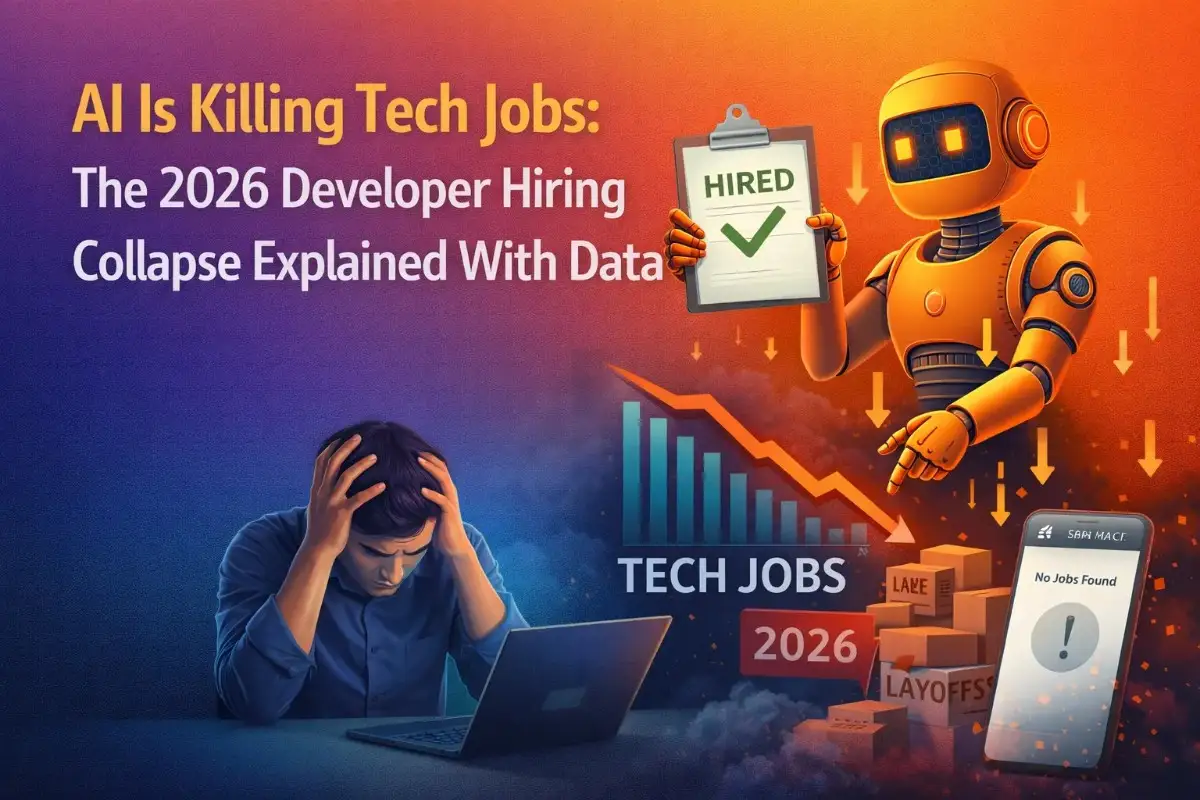
AI Is Killing Tech Jobs: The 2026 Developer Hiring Collapse Explained With Data
55,775 tech workers lost their jobs in the first 74 days of 2026. New software engineering job postings fell 15% in the first two months of the year. 20% of layoffs are now explicitly blamed on AI by the companies making the cuts, up from 8% in 2025. Entry-level developer roles are vanishing. And the companies doing the cutting are posting record revenues while their stock prices rise on the day they announce the headcount reductions. Here is what is actually happening, what the data really shows, and what every developer needs to do right now.
The Numbers: What Is Actually Happening to Tech Jobs in 2026
Before the analysis, the data. Understanding the tech job crisis of 2026 requires separating three distinct trends that are all happening simultaneously and getting conflated in most coverage: AI-driven displacement, post-pandemic correction, and structural market shift. Each has different implications. Here is the raw picture.
| Metric | Figure | Source |
|---|---|---|
| Total tech workers who lost jobs in first 74 days of 2026 | 55,775 | Layoffs.fyi / Crunchbase |
| Global tech layoffs in Q1 2026 | 45,363+ confirmed | RationalFX / Layoffs.fyi |
| U.S. tech layoffs in Q1 2026 | 30,000+ | Tech Insider |
| Share of layoffs explicitly attributed to AI by companies | 20.4% (9,238 roles) | RationalFX analysis |
| AI attribution in layoff announcements in 2025 | Fewer than 8% | Tech Insider |
| New software engineering job postings decline (Jan-Feb 2026 vs 2025) | Down 15% | LinkedIn data |
| U.S. AI-related job cuts specifically | 12,000+ | Tech Insider |
| Tech workers laid off in 2025 (full year) | 127,000 (U.S.) / 245,000 (global) | Crunchbase / Medha Cloud |
| Projected 2026 full-year tech layoffs if Q1 rate holds | 264,730 | RationalFX |
| Share of managers expecting additional layoffs in coming months | 55% | Tech Insider |
| CEOs planning to freeze or cut hiring through 2026 | 66% | Zapier / Various surveys |
| Young workers in AI-exposed roles: unemployment rise | 3% increase | Tech Insider |
| Job-finding rate drop for AI-exposed entry-level roles | Down 14% | Tech Insider |
| BLS projection for software developer employment growth (2023-2033) | +17.9% | U.S. Bureau of Labor Statistics |
| Salary premium for developers with specialized AI skills | Up to 56% higher | DemandSage |
That last data point from the Bureau of Labor Statistics deserves to sit next to the first. The same period that is seeing record tech layoffs and collapsing entry-level job postings is also the period in which the BLS projects software developer employment to grow 17.9% over the decade. The story of AI and developer jobs in 2026 is not one of universal replacement. It is one of radical redistribution.
The Real Story: Three Separate Crises Being Sold as One
Most coverage of AI job displacement treats the 2026 tech layoff wave as a single phenomenon. It is not. There are three distinct forces at work, and conflating them leads to both unnecessary panic and dangerous complacency.
Crisis 1: The Post-Pandemic Over-Hiring Correction
Tech hiring surged dramatically between 2020 and 2022 as companies bet on permanent digital acceleration. According to data from Indeed via the Federal Reserve, software engineering job postings peaked in mid-2022 and then began a sharp decline that has never recovered. This correction began before AI coding tools were mature enough to replace meaningful developer output. The companies that massively overhired during the pandemic years are still working through their workforce corrections.
Orases CEO Nick Damoulakis described this dynamic precisely: "Are jobs disappearing because of AI? Or because of timeless corporate math? Likely both: messy, intertwined, and less glamorous than the press release." The key analytical challenge is that both forces are real and both are operating simultaneously, making clean attribution nearly impossible.
Crisis 2: AI Washing: Using Artificial Intelligence as a Layoff Cover Story
Researchers analyzing the Q1 2026 layoff data have identified a troubling pattern: 80% of Q1 2026 layoffs have no direct connection to AI. They are driven by debt servicing, post-pandemic headcount correction, investor pressure for margin expansion, and financial engineering. Yet the companies executing these cuts are increasingly using AI as their public justification.
Analysts are calling this "AI washing" and the evidence is striking:
- Atlassian cut 1,600 people including over 900 from R&D in March 2026, citing an "AI-first pivot." Five months earlier, CEO Mike Cannon-Brookes had publicly pledged on a podcast that Atlassian would employ more engineers in five years and would hire more new graduates in 2025 and 2026 than in previous years. Atlassian's stock rose 2% in after-hours trading the day the layoffs were announced
- Salesforce has conducted multiple rounds of layoffs without citing AI, yet analysts note the cuts follow the same pattern of using AI efficiency narratives to justify workforce reductions
- 59% of companies framing reductions as AI-driven are doing so specifically to appeal to investors and stakeholders, according to analyst research, even when the underlying drivers are financial
- OpenAI CEO Sam Altman himself acknowledged that some companies are engaging in AI washing to use artificial intelligence as a convenient excuse for layoffs that would have happened regardless
The AI washing phenomenon matters because it distorts the real signal. When companies claim AI-driven layoffs that are actually financially motivated, it makes the genuine AI displacement that is happening (and it is happening) harder to see clearly and respond to accurately.
Crisis 3: Genuine AI Displacement, Concentrated in Entry-Level and Generalist Roles
The third and most consequential crisis is real, structural, and accelerating. AI tools are genuinely compressing team sizes, particularly in entry-level and junior developer roles. The mechanism is not that AI replaces a developer directly. It is that a senior developer using AI tools can now produce what previously required a team of four, eliminating the need to hire junior developers to handle the lower-complexity work.
Heather Doshay, head of people at SignalFire, told the New York Times: "Nobody has patience or time for hand-holding in this new environment, where a lot of the work can be done by AI." Companies that previously hired junior developers with three to six month ramp-up periods now expect immediate productivity. That expectation disqualifies most entry-level candidates.
Company by Company: Who Is Cutting and Why
Here are the most significant AI-attributed tech layoffs of Q1 2026, with the real story behind each announcement.
| Company | Jobs Cut | Official Reason | What the Data Shows |
|---|---|---|---|
| Block (Square / Cash App) | 4,000 (40% of workforce) | CEO Jack Dorsey: company "embraced AI" | Q4 gross profit $2.87B (up 26% YoY). Same revenue now requires 6,000 employees vs 10,000 previously. Genuine AI productivity gain confirmed by financials |
| WiseTech Global | 2,000 (25% of workforce) | AI dramatically increasing software engineering productivity, traditional code writing becoming obsolete | Most significant non-U.S. AI-attributed layoff of Q1 2026. Executives cited LLMs transforming logistics platform maintenance |
| Atlassian | 1,600 (10% of workforce, 900+ from R&D) | AI-first pivot, redirecting to AI and enterprise sales | CEO pledged more engineers 5 months before cuts. Stock rose on announcement. Classic AI-washing pattern |
| Meta | 1,500 (Reality Labs) | Redirecting resources to AI R&D | Meta spending $115-135B on AI capex in 2026. Cutting non-core divisions to fund AI infrastructure |
| Livspace | 1,000 | AI-driven interior design platform reducing human consultants | Direct AI displacement in design and customer-facing roles |
| eBay | 800 | AI efficiency gains | Customer service and listing management functions automated |
| 675 (15% of workforce) | Redirect to AI-focused teams and products | Combined AI restructuring and advertising revenue pressure from tariff-related retail pullback | |
| ASML | 1,700 | Reducing management layers, shifting to engineering roles | Posted record €32.7B revenue in 2025. Organizational restructuring, not AI displacement |
| Amazon | 16,000 (January 2026) | AI-driven efficiency, workforce optimization | Deployed one-millionth warehouse robot in Q1 2026. Both corporate and operational automation occurring simultaneously |
The Block example is the clearest case of genuine AI-driven productivity transformation in the data. Dorsey's company is generating 26% more gross profit with 40% fewer employees. That is not a narrative. It is an audited financial result. The companies citing AI while maintaining or growing revenue are the ones where the productivity claim deserves scrutiny. The companies citing AI while their headcount-to-revenue ratio actually improves are providing real evidence of displacement.
The Entry-Level Developer Crisis: The Specific Jobs That Are Disappearing
While senior and specialized engineers retain strong demand, the entry-level developer market has experienced what several analysts are calling a structural collapse. This is the segment where AI displacement is most concentrated, most measurable, and most consequential for the next generation of developers.
The mechanism is not that companies are firing junior developers. It is that they are not hiring them in the first place. Consider what has changed in 2026:
- A single senior developer using Claude Code, Cursor, or GitHub Copilot now produces output that previously required a team of three to four, eliminating the need to hire junior developers for lower-complexity work
- Companies that previously used junior developer hiring as an investment in future senior talent pipeline are cutting that investment in favor of immediate AI productivity gains
- The "3 to 6 month onboarding period" that entry-level hires previously required is now viewed as an unacceptable cost when AI tools can perform the same output immediately
- New graduate employers' outlook is at its most pessimistic since 2020, per NACE's Job Outlook 2026 survey
- Job-finding rates for AI-exposed entry-level roles have dropped 14% since advanced AI coding tools became mainstream
- Young workers in AI-exposed roles experienced a 3% rise in unemployment specifically tied to the launch of advanced AI tools
Anthropic CEO Dario Amodei issued a stark warning in his February 2026 economic essay: AI could wipe out half of all entry-level white-collar jobs within five years, pushing unemployment toward 10 to 20% in the short term. That is a projection from the CEO of the company building one of the most widely used AI coding tools in the world. It deserves to be taken seriously.
Hugo Malan, president of the science, engineering, technology and telecom reporting unit at staffing agency Kelly Services, offered a more structural framing: "This is a tectonic shift. AI agents are not poised to replace workers one-to-one. Instead, there will be a realignment of which jobs are needed, and what those roles look like."
The Other Side of the Data: What AI Is Creating
The 2026 tech job story cannot be told honestly by looking only at layoffs. The same period that is seeing record AI-attributed job cuts is also generating new categories of employment at rates that no previous technology wave has matched.
The counter-narrative from the data is compelling:
- AI Engineer roles are growing at over 140%, making it one of the fastest-growing careers in any field
- AI Content Creator positions have grown by more than 130%
- Roles including Prompt Engineer, AI Solutions Architect, and AI Product Manager are growing at rates between 35% and 110%
- LinkedIn reports AI job postings are up 21x in the U.S. since ChatGPT launched
- Professionals with specialized AI skills now command salaries up to 56% higher than peers in identical roles without those skills
- The World Economic Forum projects that while AI will displace millions of jobs by 2030, it will simultaneously create 170 million new ones, for a net gain of 78 million positions
- Deloitte's Tech Trends 2026 projects the number of people building software will grow from 30 million professional developers today to over 100 million citizen developers by 2028
The World Economic Forum's research on software developers specifically, published in January 2026, identified a striking pattern: four in ten developers said AI had already expanded their career opportunities in 2025, and close to seven in ten expect their role to change further in 2026. The response has been adaptive rather than defensive. A third of developers now rank GenAI and AI/ML as their top learning priorities, and 65% expect their role to be redefined toward architecture, integration, and AI-enabled decision-making rather than routine coding.
"Software developers are becoming the first truly AI-native workforce, showing how every knowledge worker will evolve."
World Economic Forum, Software Developers and the Future of Work, January 2026
The pattern that emerges from an honest reading of all the data is not replacement. It is bifurcation. Developers who adapt and specialize are experiencing significant career expansion. Developers who do not are experiencing the same displacement as every other category of knowledge worker that AI tools have reached.
The AI Washing Problem: Why the Real Displacement Is Being Obscured
One of the most underappreciated dynamics in the 2026 tech job story is how AI washing is making the genuine displacement harder to measure and respond to. When companies cite AI as the reason for financially motivated layoffs, they pollute the signal that developers and policymakers need to understand which jobs are actually under threat.
Consider what happens when a company cites AI for a layoff that is actually driven by post-pandemic over-hiring correction or investor pressure for margin expansion. That layoff gets counted as AI displacement. Workers who lost jobs for structural financial reasons believe they were automated out of existence. The public discourse around AI job risk becomes inflated. And the genuine AI displacement that is happening, in entry-level coding, in customer service, and in content moderation, gets lost in the noise of exaggerated claims.
Rest of World's January 2026 analysis of the tech job market identified the central contradiction: "Companies are laying off staff, insisting artificial intelligence will 'do more with less', yet they haven't found ways to deploy AI at scale." Only 14% of organizations surveyed by Deloitte have AI solutions ready for production deployment. Only 11% are actively using agentic systems in production. The companies claiming massive AI productivity gains that justify mass layoffs are largely companies that have not yet successfully deployed AI at the scale they are advertising to investors.
MIT and Oxford researchers found that 95% of companies investing in AI are getting zero measurable return on that investment. For every Block that can demonstrate a 26% revenue increase with 40% fewer employees, there are dozens of companies claiming AI productivity gains that their financial results do not support.
What Every Developer Must Do Right Now to Survive and Thrive in 2026
The bifurcation in the developer job market is real and it is widening. The developers who are thriving in 2026 have made specific, identifiable moves. Here is exactly what those moves are.
1. Stop Being a Generalist and Start Being an Expert
The market for generalist developers who can write standard CRUD applications, do basic frontend work, and handle routine backend tasks is shrinking because AI tools handle those tasks acceptably. The market for developers with deep expertise in specific domains is growing because AI tools cannot replicate the judgment, context, and domain knowledge that genuine specialization requires. Pick a domain: AI/ML infrastructure, distributed systems, security engineering, data architecture, or embedded systems. Go deep, not broad.
2. Make AI Tools Your Most Fluent Programming Language
The single most important skill for any developer in 2026 is effective use of AI coding tools. Not superficial familiarity, deep fluency. Developers who can direct Claude Code, GitHub Copilot, or Cursor to execute complex multi-file refactors, generate comprehensive test suites, and reason about architectural tradeoffs are producing output at a rate that makes them disproportionately valuable. The developers at risk are those treating AI tools as optional convenience features rather than primary workflow infrastructure.
- 95% of developers now use AI tools weekly, but only a fraction use them at their full capability
- Claude Code is currently the No.1 most loved AI tool among engineers at 46%, worth learning deeply
- Update your resume and portfolio to demonstrate AI-assisted development experience explicitly: this is now table stakes for hiring in 2026
3. Move Toward Architecture and System Design
AI tools are extremely capable at implementing specified solutions. They are not capable of determining what to build, how systems should interact, what tradeoffs are acceptable, and how to make architectural decisions that will remain maintainable at scale. The developer who designs the system that AI agents then implement is far more defensible than the developer who implements systems designed by others.
The WEF data confirms this directionally: 65% of developers expect their role to be redefined in 2026 toward architecture, integration, and AI-enabled decision-making. Getting ahead of that redefinition rather than reacting to it is the difference between a career transition that is chosen and one that is forced.
4. Build AI Governance and Observability Skills
As the Amazon Kiro incident, the CrowdStrike report, and dozens of smaller AI production failures have demonstrated in 2026, every organization that deploys AI agents in production needs engineers who understand how to govern them safely. This is a new engineering discipline with almost no experienced practitioners and enormous demand. Skills in AI observability, agent evaluation frameworks, safety architecture, and production incident response for AI systems are among the highest-value technical capabilities in the 2026 job market.
5. Look Beyond Big Tech
The companies making the deepest AI-attributed cuts are concentrated in software platforms and fintech. Meanwhile, healthcare, energy, manufacturing, and government are actively hiring tech talent for digital transformation projects that have nothing to do with the AI hype cycle. Industries with large amounts of domain-specific complexity, regulated data environments, and physical-world integration requirements are underserved by AI tools and desperately need experienced engineers.
6. Treat Demonstrated Skills as More Important Than Credentials
Mike Roberts, founder and CEO of the nonprofit Creating Coding Careers, identified the core problem for entry-level developers precisely: "Often, students in a more traditional computer-software degree program get a lot of theoretical knowledge, but they may not have much experience building software on a team." In 2026, employers want demonstrated proficiency, not theoretical knowledge. Build public projects. Contribute to open source. Ship AI-assisted applications. Create the portfolio evidence that a degree no longer provides by default.
Frequently Asked Questions
Is AI really replacing software developers in 2026?
Partially, selectively, and not in the way most headlines suggest. Of the 45,363 confirmed tech layoffs through early March 2026, only 20.4% were explicitly linked to AI by the companies themselves. The U.S. Bureau of Labor Statistics still projects software developer employment to grow 17.9% between 2023 and 2033. However, entry-level and junior developer roles are shrinking significantly, new job postings fell 15% in the first two months of 2026, and AI tools are compressing team sizes. The accurate picture is selective displacement, not wholesale replacement.
How many tech jobs have been lost to AI in 2026?
55,775 tech workers lost jobs in the first 74 days of 2026 according to tracking by Layoffs.fyi and Crunchbase. Of the 45,363 confirmed tech layoffs through early March, approximately 9,238, or 20.4%, were explicitly linked to AI and automation by the companies themselves. This is a dramatic increase from 2025, when AI was cited as a factor in fewer than 8% of layoff announcements.
What is AI washing in tech layoffs?
AI washing is the practice of companies citing artificial intelligence as the primary reason for layoffs when the actual drivers include debt servicing, post-pandemic over-hiring correction, and investor pressure for margin expansion. Researchers found that 80% of Q1 2026 layoffs had nothing directly to do with AI. Sam Altman himself acknowledged some companies are engaging in AI washing to use AI as a convenient excuse for financially motivated cuts.
Are entry-level developer jobs really disappearing?
Yes, entry-level developer roles are the most severely affected segment. Job-finding rates for AI-exposed entry-level roles dropped 14%. Companies that previously hired junior developers with three to six month ramp-up periods now expect immediate productivity. Anthropic CEO Dario Amodei warned AI could wipe out half of all entry-level white-collar jobs within five years. The mechanism is not direct replacement but compression of team sizes, eliminating the need to hire junior developers for lower-complexity work.
What skills do developers need to survive the AI job market?
Developers thriving in 2026 have moved toward deep specialization, AI tool fluency, system architecture, AI governance skills, and demonstrated project portfolios. Python for AI and ML work, proficiency with Claude Code and GitHub Copilot, and experience shipping AI-assisted products are now baseline expectations. Professionals with specialized AI skills command salaries up to 56% higher than peers without those skills.
Will software developer jobs grow or shrink overall by 2033?
Despite the current disruption, the U.S. Bureau of Labor Statistics projects software developer employment to grow 17.9% between 2023 and 2033, much faster than the average for all occupations. The World Economic Forum projects AI will create 170 million new jobs globally while displacing fewer, for a net gain of 78 million positions. The growth will be concentrated in AI-adjacent roles, architecture, and specialized engineering, while generalist and entry-level roles continue to contract.
Final Thoughts: This Is a Redistribution, Not an Extinction
The honest answer to "is AI killing developer jobs?" is: yes and no, in ways that matter enormously depending on which developer you are.
For developers in entry-level and generalist roles, 2026 is genuinely difficult. The pipeline that used to absorb new graduates through a ramp-up period has thinned dramatically. Companies are smaller, expectations are higher, and the tolerance for developers who cannot contribute immediately has essentially disappeared. This is a real and painful structural change that is affecting real people trying to start careers.
For developers with deep specialization, AI fluency, and architectural judgment, 2026 is one of the strongest job markets in a decade. The premium for AI-adjacent skills is 56% over equivalent roles without them. The demand for engineers who can govern, evaluate, and architect AI systems significantly outstrips supply. The WEF finding that four in ten developers say AI has already expanded their career opportunities is not a public relations talking point. It is reflecting the experience of a specific category of developer who adapted early.
The bifurcation will continue. Companies will get better at deploying AI tools at scale. The productivity gains that are currently being claimed but not yet fully realized will become real, and team sizes will compress further. The entry-level developer market will remain constrained. The architecture and AI systems market will expand.
The developer who survives and thrives in this environment is not the one waiting to see how this plays out. It is the one who is building the skills, portfolio, and specialization that make them the engineer AI tools make more productive rather than the engineer AI tools make redundant.
The window to make that transition is open right now. It will not stay open indefinitely.
💡 Strategic Insight
This isn't just technical knowledge, it's the kind of engineering thinking that separates production systems from toy projects. Apply these patterns to reduce costs, improve reliability, and ship faster.
Frequently Asked Questions
Partially, selectively, and not in the way most headlines suggest. Of the 45,363 confirmed tech layoffs through early March 2026, only 20.4% were explicitly linked to AI by the companies themselves. However, entry-level and junior developer roles are shrinking significantly, new job postings fell 15%, and AI tools are compressing team sizes.
55,775 tech workers lost jobs in the first 74 days of 2026 according to tracking by Layoffs.fyi and Crunchbase. Approximately 9,238, or 20.4%, were explicitly linked to AI and automation by the companies themselves, up from 8% in 2025.
AI washing is the practice of companies citing artificial intelligence as the primary reason for layoffs when the actual drivers include debt servicing, post-pandemic over-hiring correction, and investor pressure for margin expansion. Researchers found that 80% of Q1 2026 layoffs had nothing directly to do with AI.
Yes, entry-level developer roles are the most severely affected segment. Job-finding rates have dropped 14%. Companies now expect immediate productivity rather than 3-6 month ramp-up periods, often used to justify compression of team sizes through AI tools.
Key skills include deep specialization, AI tool fluency (Claude Code, GitHub Copilot), system architecture, AI governance, and demonstrated experience shipping AI-assisted products. Professionals with specialized AI skills now command salaries up to 56% higher than peers.
Tagged with
TL;DR
- Stop being a generalist and start being an expert in specific domains like AI/ML infrastructure or distributed systems.
- Make AI tools like Claude Code, GitHub Copilot, or Cursor your most fluent programming language and primary workflow infrastructure.
- Move toward architecture and system design where judgment, context, and domain knowledge are prioritized over implementation.
- Build AI governance and observability skills as organizations move toward deploying autonomous agentic systems in production.
- Look beyond Big Tech to sectors like healthcare, energy, and manufacturing that are underserved by the AI hype cycle.
- Prioritize demonstrated proficiency and shipping AI-assisted applications over traditional degrees and theoretical knowledge.
Need help implementing this?
I help teams architect scalable systems, build AI-powered applications, and ship production-ready software.

Written by
Gaurav Garg
Full Stack & AI Developer · Building scalable systems
I write engineering breakdowns of major tech events, architecture deep dives, and practical guides based on real production experience. Every post is built from code, not theory.
7+
Articles
5+
Yrs Exp.
500+
Readers
Get tech breakdowns before everyone else
Engineering insights on AI, cloud, and modern architecture, delivered when it matters. No spam.
Join 500+ engineers. Unsubscribe anytime.