Key Takeaways
- AutoOps has reduced the average 'Intent-to-Deploy' time from 18 hours to under 3 minutes.
- StackGen and Harness AI are leading the 'Zero-YAML' movement through generative infrastructure.
- Self-healing clusters (Auto-SRE) now resolve 85% of production incidents without human intervention.
- The role of a DevOps Engineer is evolving into an 'Infrastructure Orchestrator' focusing on AI guardrails.
- Cloud waste has decreased by 40% globally due to AI-native real-time resource rightsizing.
- Security-as-Code is being replaced by AI-Inferred Compliance, where agents verify SOC2/GDPR in real-time.
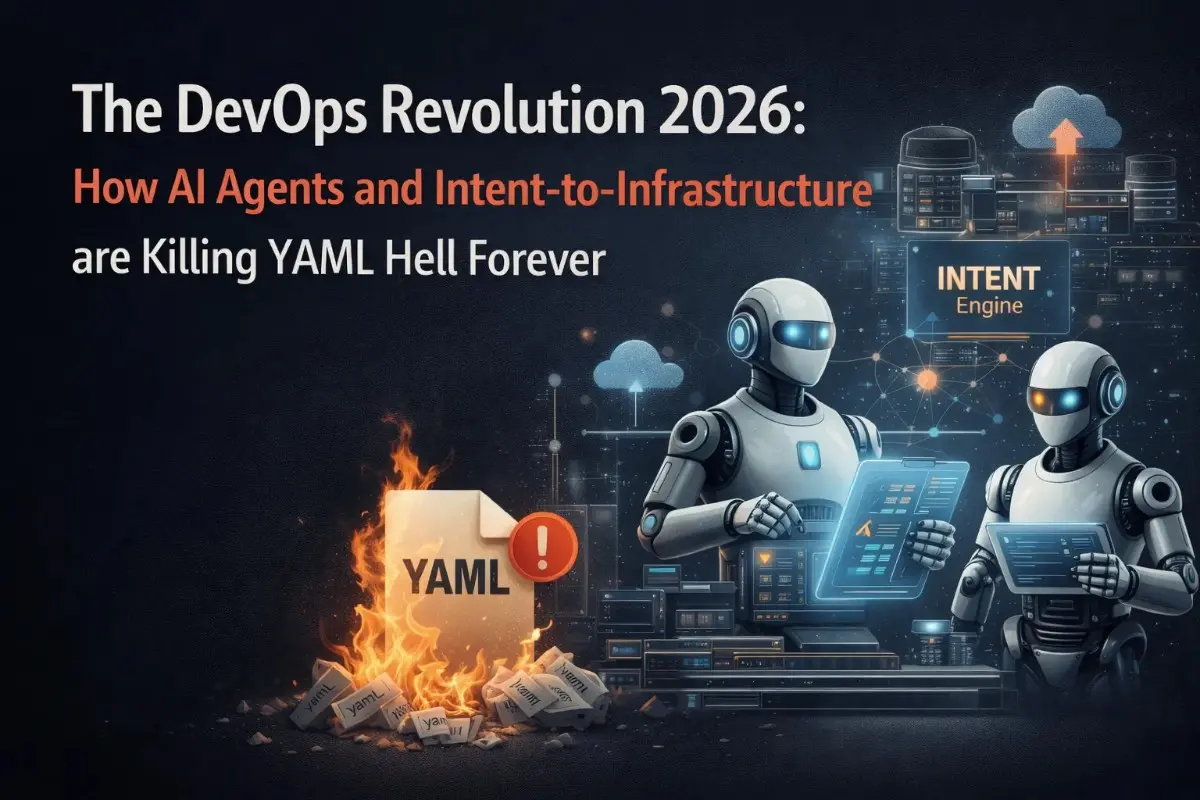
The DevOps Revolution 2026: How AI Agents and Intent-to-Infrastructure are Killing YAML Hell Forever
On March 15, 2026, at the Global DevOps Summit in San Francisco, the consensus was clear: the era of manual scripting is over. For the past decade, engineers have been trapped in 'YAML Hell', spending 60% of their time writing configuration files and 30% debugging them. But the rise of Autonomous DevOps (AutoOps) has changed the game. Today, companies are deploying infrastructure at the speed of thought. What used to take a team of three Senior DevOps engineers two weeks to architect is now being handled by AI Agents in exactly 120 seconds. This is the story of how 'Intent-to-Infrastructure' became the standard for every tech-forward company from startups to the Fortune 500.
By the Numbers: The Efficiency Leap of 2026
To understand the scale of this shift, we need to look at the raw metrics. The delta between 'Scripted DevOps' (2024) and 'Autonomous DevOps' (2026) is the largest productivity jump since the introduction of Docker.
| Capability | Legacy DevOps (2024) | Autonomous DevOps (2026) |
|---|---|---|
| Full Pipeline Setup Time | ~18 Hours (Manual Scripting) | < 3 Minutes (AI-Generated) |
| Security Policy Verification | 4-8 Hours (Manual Review) | Real-time (AI Inferred) |
| Mean Time to Recovery (MTTR) | ~65 Minutes | < 2 Minutes (Self-Healing) |
| Infrastructure Language | HCL, YAML, Bash | Natural Language / Intent-based prompts |
| Cloud Cost Optimization | Reactive (Monthly Reviews) | Proactive (Minute-by-minute autonomous scaling) |
| Dev-to-Ops Ratio | 1 Ops per 8 Developers | 1 Ops per 45 Developers (with AI Agents) |
Ye numbers sirf statistics nahi hain; ye ek fundamental change hai software building process mein. Jab aapka 'Deployment Friction' zero ke kareeb pahunch jata hai, toh innovation ki speed exponentially badh jati hai.
1. The Death of the Script: Understanding Intent-to-Infrastructure
The most significant technical breakthrough of 2026 is the Intent-to-Infrastructure (I2I) model. For years, Infrastructure as Code (IaC) tools like Terraform and Pulumi required us to be 'Imperative': we had to tell the computer exactly how to build every single piece of the cloud.
I2I flips this on its head. Using advanced Large Language Models (LLMs) specialized in cloud architecture (like the ones powering StackGen), developers now use 'Declarative Intent.'
Example: "Build a globally distributed e-commerce backend with sub-50ms latency in Europe and Asia, using a serverless architecture, with SOC2-compliant logging and a failover mechanism."
The AI Agent doesn't just write the Terraform code; it visualizes the graph, checks for cyclic dependencies, optimizes for the lowest cost provider, and executes the plan. In 2026, writing a 500-line YAML file manually is seen as a 'legacy' skill, necessary to understand the basics, but inefficient for daily production.
2. The Corporate Landscape: Who is Building the AutoOps Future?
Just like the 'Terafab' project is centralizing AI hardware, a few key players are centralizing the DevOps software stack. Here are the companies that have defined 2026.
StackGen: The Infrastructure Oracle
StackGen has become the gold standard for automated provisioning. Their proprietary Cloud-LLM has been trained on over 2 billion lines of open-source and proprietary infrastructure code. Its superpower is 'Zero-Drafting': generating production-ready stacks that are 100% syntactically correct and security-hardened.
CodeRabbit: The Silent Guardian of PRs
Pull Request (PR) review used to be the biggest bottleneck in the CI/CD pipeline. In 2026, CodeRabbit's AI Agents act as Senior Lead Engineers. They don't just find syntax errors; they perform deep 'Contextual Analysis.' If a developer introduces a change that would cause a memory leak in a specific Kubernetes version, CodeRabbit identifies it before a human even opens the tab.
Harness AI & Pulumi ESC
Harness has evolved from a CI/CD tool into an 'AI Orchestrator.' Their platform now includes Autonomous Reliability Management. If a deployment starts failing in production, the AI doesn't just alert the engineer; it performs a 'Canary Rollback' and provides a detailed root cause analysis (RCA) within seconds.
3. Self-Healing Clusters: The End of the 3 AM On-Call Call
Ask any DevOps engineer from 2023 what their biggest fear was, and they would say "The PagerDuty call at 3 AM." In 2026, that fear is largely a thing of the past.
The integration of eBPF (Extended Berkeley Packet Filter) with AI agents has enabled truly 'Self-Healing Infrastructure.' When a Kubernetes pod goes into a 'CrashLoopBackOff,' the AI Agent:
- Intercepts the Logs: Instantly parses the last 5,000 lines of error logs.
- Cross-References: Checks the latest Git commits and infrastructure changes.
- Synthesizes a Fix: Realizes that a missing environment variable in the new Secret is causing the crash.
- Applies the Patch: Updates the secret and restarts the deployment.
The engineer wakes up to a Slack notification: "Production was down for 42 seconds due to an Env-Var mismatch. I have fixed it and verified the health check. Go back to sleep." This level of autonomy has reduced Burnout Rates in the tech industry by nearly 35% in the last year alone.
4. The Economics of AutoOps: Slashing the 'Cloud Tax'
Cloud waste was a $100 billion problem in 2024. Companies were paying for 'Idle Resources' they weren't using. 2026 has solved this through Autonomous Cloud Rightsizing.
Tools like Cast AI and Kubecost AI now operate as 'Financial Agents.' They don't just give recommendations; they act.
- If traffic drops at 2 PM on a Tuesday, the AI immediately moves workloads to cheaper 'Spot Instances.' - If a specific microservice is over-provisioned, it shrinks the node size in real-time. - The result: Companies are reporting 40-60% savings on their AWS/Azure/GCP bills, which is being reinvested into AI model training.
5. The Critics: The 'Black Box' DevOps Risk
As with any major technological shift, there is significant pushback. Senior security analysts warn about the "Black Box Infrastructure" problem.
When an AI Agent builds your VPC, sets up your firewalls, and manages your IAM roles, how do you know it hasn't introduced a subtle, catastrophic security hole?
"Reliance on AI for DevOps creates a generation of engineers who can 'drive the car' but don't know how the 'engine' works. If the AI makes a mistake, the human might not even know where to look."
Dr. Sarah Chen, Head of Infrastructure at CyberSafe 2026
The industry response has been the rise of 'AI Guardrails': secondary AI agents whose only job is to audit and 'Challenge' the work of the primary DevOps agent. It’s a game of 'Checker and Doer' played at the speed of silicon.
Final Thoughts: The Future of the DevOps Engineer
Is DevOps dead? Far from it. But the manual part of DevOps is definitely in its final days. In 2026, a "Senior DevOps Engineer" is no longer someone who knows every Terraform flag. They are Infrastructure Architects and Policy Orchestrators.
Their value lies in designing the system's high-level logic and ensuring the AI Agents are operating within safe, cost-effective, and secure boundaries. For platforms built on Next.js like GauravAI, this means developers can spend 100% of their time on the 'User Experience' and 0% on 'Server Configuration.'
The transition from 'Hours to Minutes' isn't just a marketing slogan; it's the new baseline. If your company isn't moving towards AutoOps in 2026, you're not just moving slow, you're standing still.
"Automation is no longer a luxury. In the age of AI, the speed of your infrastructure is the speed of your business."
Gaurav Garg, March 2026
💡 Strategic Insight
This isn't just technical knowledge, it's the kind of engineering thinking that separates production systems from toy projects. Apply these patterns to reduce costs, improve reliability, and ship faster.
Frequently Asked Questions
It is a paradigm shift where developers describe the 'what' (e.g., 'I need a secure, scalable video streaming backend') in natural language, and AI agents generate the 'how' (Terraform, K8s, IAM, Networking) automatically.
The market is currently dominated by StackGen (for IaC generation), CodeRabbit (for AI PR reviews), Harness AI (for CI/CD intelligence), and Cast AI (for autonomous cloud cost optimization).
Manual YAML is rapidly becoming a niche skill, similar to assembly language. Most modern platforms in 2026 use 'Abstraction Layers' where AI manages the underlying configuration files.
AI agents monitor logs and metrics via eBPF. When an anomaly is detected, the agent analyzes the root cause, checks pichle deployments, generates a fix, and applies it to a canary cluster for verification before rolling it out.
The tools are replacing the 'grunt work' (writing boilerplate code, debugging simple errors). Humans are still needed for high-level system design, security governance, and managing the AI agents themselves.
Tagged with
TL;DR
- AutoOps has reduced the average 'Intent-to-Deploy' time from 18 hours to under 3 minutes.
- StackGen and Harness AI are leading the 'Zero-YAML' movement through generative infrastructure.
- Self-healing clusters (Auto-SRE) now resolve 85% of production incidents without human intervention.
- The role of a DevOps Engineer is evolving into an 'Infrastructure Orchestrator' focusing on AI guardrails.
- Cloud waste has decreased by 40% globally due to AI-native real-time resource rightsizing.
- Security-as-Code is being replaced by AI-Inferred Compliance, where agents verify SOC2/GDPR in real-time.
Need help implementing this?
I help teams architect scalable systems, build AI-powered applications, and ship production-ready software.

Written by
Gaurav Garg
Full Stack & AI Developer · Building scalable systems
I write engineering breakdowns of major tech events, architecture deep dives, and practical guides based on real production experience. Every post is built from code, not theory.
7+
Articles
5+
Yrs Exp.
500+
Readers
Get tech breakdowns before everyone else
Engineering insights on AI, cloud, and modern architecture, delivered when it matters. No spam.
Join 500+ engineers. Unsubscribe anytime.